

I was out on the back patio the other day, laptop open, feet up, staring at the grass with a blank page in front of me and one of those endless “mental runways” that you can’t see the end of. The pups were doing their thing next to me, and I was doing that internal dialogue, asking myself some version of “what can I ACTUALLY make with what I have right now?”
And there I was, just sitting on an idea I’d been carrying around for a minute, because the distance between the idea and the finished thing always seemed incredibly daunting. So I decided to stop admiring the Arizona-sized chasm and hard reverse to the cheapest, smallest, most fully mine version of it I could find. “Practice what I preach”, as they say.
So here’s the idea I’ve been sitting on:
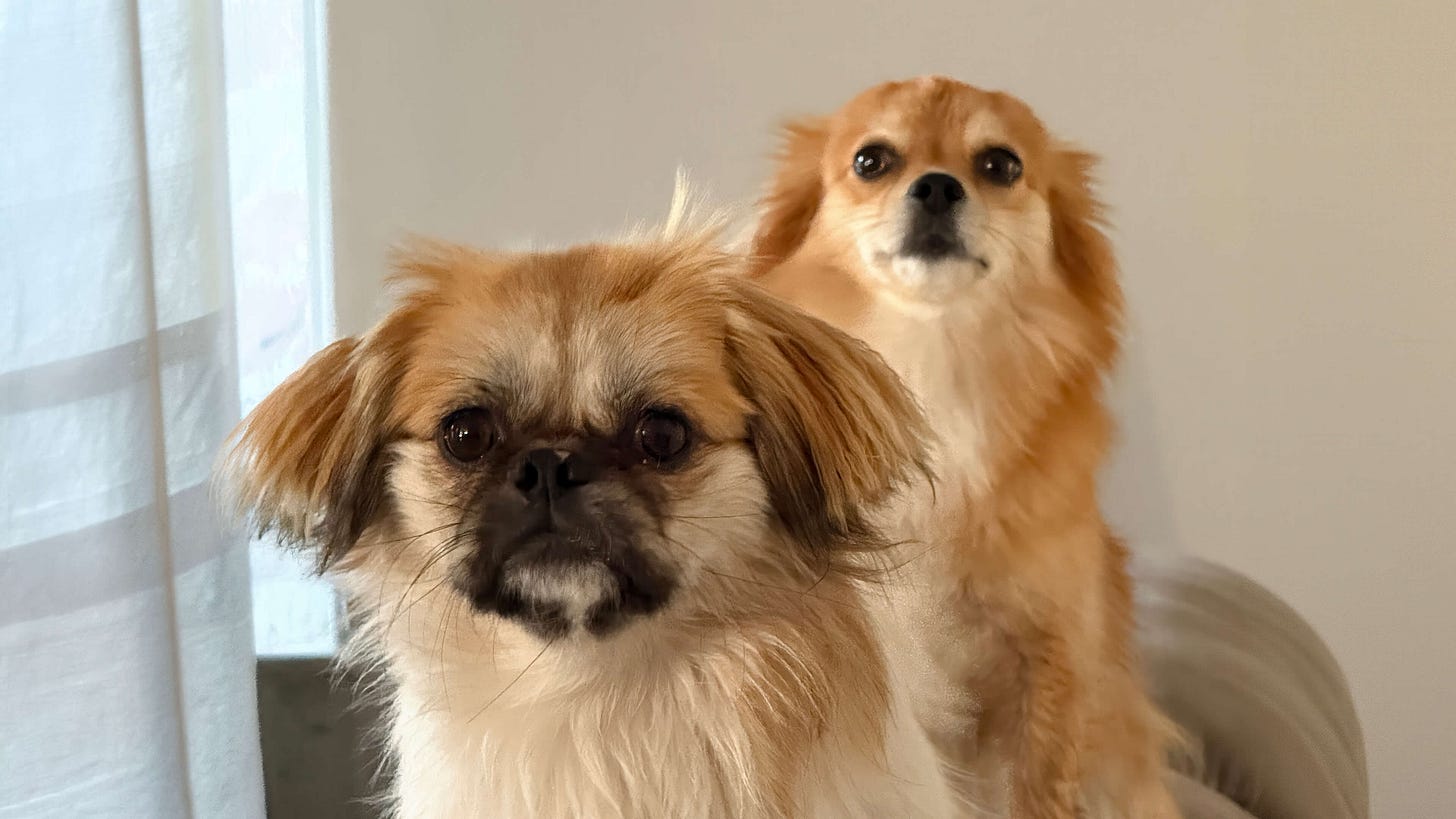
“What brains?”
It started, like most things, as a joke about my dog. Sophie (aka Sophi) is our “sweet as anything” Pekingese. She’s endlessly curious, and running on roughly three brain cells that mostly focus on snacks (or anything snack-adjacent). She moves through the world like nothing could ever happen to her (which is incredibly apparent when she crosses the highway without a care in the world).
So one day the premise just wrote itself: my wife and I often look at her clueless expression and say, “what brains?” And since the undead want brains, and Sophi doesn’t really have any to offer, she’d be perfectly safe in a zombie apocalypse. She’d wander straight through a horde, blissfully unbothered, greeting everything like a parade of new friends while everything else runs screaming.
Her partner in all this is Zoey (aka Zoë), our very real, very anxious Pomchi, who is convinced the Grim Reaper is riding behind her at all times and treats every car ride, mailman, and vacuum as a possible threat. Drop her into an “actual” apocalypse and she finally has a real reason to panic, which somehow only makes her funnier. Zoë thinks too much, Sophi thinks too little, and that gap is the whole story engine. Same broken-down street, two completely different realities. One sees certain doom, the other sees possibility (and probably a snack). Zoë’s fear comes from loyalty and Sophi’s cluelessness comes from pure joy, so neither one is disposable comic relief.
Now here’s the part that actually matters for anyone who isn’t me and doesn’t care about my dogs, which is totally fair.
If you told the industry you wanted to make an animated series, the path for a long time was pretty straightforward: you write a pilot, you get coverage, and you (ideally) land an agent or manager. THEN you take it out and pitch it to studio (after studio), hoping one of them decides to pick it up.
And I’ve walked enough of that road to know where it usually ends, so I’ve decided to do this backwards, on purpose. The plan is basically a ladder with three rungs: first the short story, then a comic (or webtoon), then the fully produced animation. Each rung is its own finished thing, but it also serves as proof of concept for the next. It all starts with the story because I fundamentally believe that “story” is the foundation of the entire (damned) thing. Strip away the animation, the imagery, and all the extra fluff, and you’re left with the writing, which is both the cheapest part to make and the most important part to get right.
And that’s where the webcomic, or second rung, comes in. When the Wachowskis were selling the vision for “The Matrix,” the script got them in the door, but what helped people actually “see” the movie in their heads was an enormous comics-style storyboard package, the thing people loosely (and not-quite-accurately) call a graphic novel. A picture can prove a vision in a way a page of description never quite can.
As of right now, I’m at the very beginning of this thing. I’m standing at the bottom of the ladder with one hand on the first rung. I’m breaking the season into beats, mapping the major turning points, working through the backstory, and figuring out what I want viewers to walk away with. The whole season is built around one central idea: fear keeps you alive, but love is what brings you back to life. Which, in a story full of zombies, is less of a metaphor than you might think.
My vision is roughly eighteen episodes, each a minute or two long, which adds up to something like a thirty-minute season if you stack them end to end. It’s a warm, comedy-first project I’m calling “Paws of the Apocalypse”: bite-sized, easy to share, and small enough to actually finish. More than anything, it’s an experiment I get to run in public, and I think that’s part of the fun.
Where it gets expensive (and a little scary)
Now I want to be straight about the whole ladder concept, because as much as we’d like it to be, it isn’t all free.
The only truly zero-dollar thing is the first one. The short stories, or in my case “episodes,” are mostly a few days of brainstorming, writing, rewriting, and eventually hitting publish. The comic gets a little more involved because even if you’re using AI to help generate the images, those generations cost a few bucks, especially once you start making constant variations trying to get something right. And then animation is where the real money starts to show up. Suddenly you’re generating animated clips, trying to keep the look and feel consistent, and eventually bringing in voice actors. So just know that going in the writing is the part you can do at zero, and the rungs above it ask for a little more each time.
There’s also an honest crack in this whole plan, and I think it’s worth calling out. You might climb onto that first rung, discover you love writing short stories, and happily stay there forever, which is completely fine. But my goal with this project is to go the whole distance, from a “napkin idea” to a finished show, even if only three people watch it and my wife is one of them. And that brings me to the actually scary part: you’ve got to be okay with watching the thing flop, which sucks and is super vulnerable. But here’s the deal: I’m doing it anyway, because I genuinely love making things and telling stories, whether one person shows up or a thousand do.
The part nobody has to greenlight
The goal with this was never to get someone to greenlight it. The goal is to build the part I actually own, which is the work itself.
This isn’t me assembling some slick development package to wave around at investors. It feels much closer to grabbing a camcorder and making a home movie with your friends for no other reason than it sounds fun. It’s taking an idea that only exists in your head and turning it into something real. That’s it. Full stop.
So, this is where I hop onto my high horse and say that if you’ve got your own story sitting in a drawer, and I suspect a lot of you reading this do, consider this a digital high-five and a kick in the pants. Mine happens to be an animated series, but I’ve got an entire graveyard of grandiose, absurd scripts and concepts from over the years, and almost every one of them could be repurposed into something I could start making this week. That feature you can’t afford to shoot? Maybe it becomes a web novel on something like Royal Road, with each scene becoming a chapter. Whatever the expensive version of your idea is, there’s probably a version you can start building right now for little more than the price of your time. And the beautiful side effect is that, while you’re making it, you also have a chance to find the people who might actually care about it before the expensive version ever exists.
So here’s me planting the flag. I’m going to write these episodes as short stories and post every single one here on Substack, open to everybody. I’d love for you to come along for the wins, and the almost-certain faceplants.
I’m so freakin’ pumped to figure this out in the open, and I can’t wait to see what you all think of two very small dogs trying to survive the end of the world. 🍿
Let’s make something awesome.
Cheers!
~ Corbin
Editor’s Note: This essay reflects Corbin Schweitzer’s personal perspective as a filmmaker, and member of the KDMG creative team.